How Do Endoscopes Enhance Diagnostic Accuracy in Medicine?

Time:2026-05-31 Author:Liam
0%

Endoscopes represent a significant advancement in modern medicine. They provide a detailed view of internal organs, enhancing diagnostic possibilities. Dr. Sarah Caldwell, a leading gastroenterologist, states, “How do endoscopes improve diagnostic accuracy? They allow us to see what traditional imaging cannot.” This perspective emphasizes the unique advantages of endoscopic procedures.

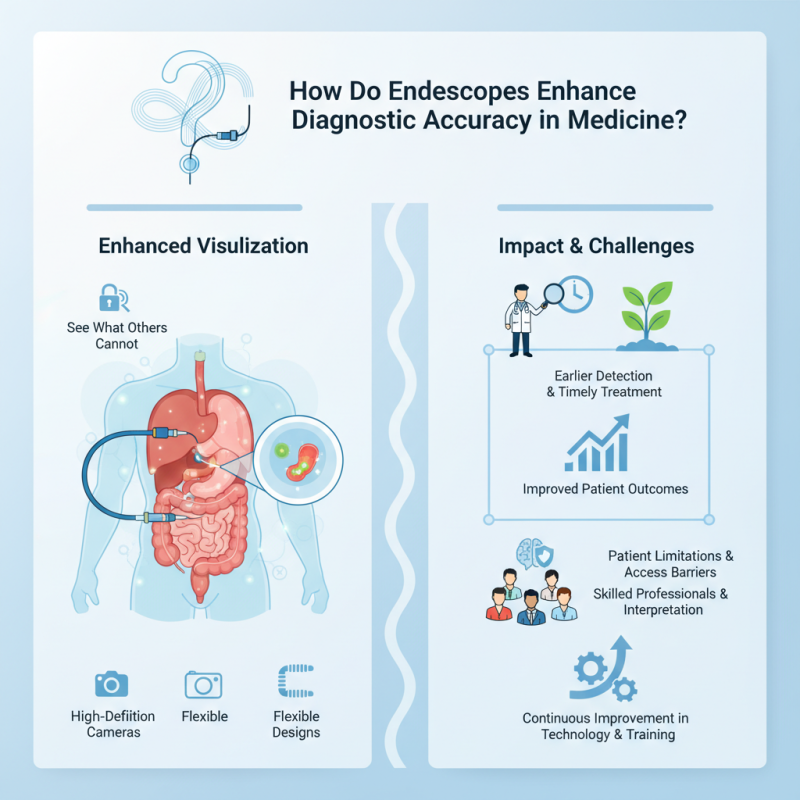
As technology evolves, endoscopes have become more sophisticated. High-definition cameras and flexible designs allow for better visualization. Physicians can identify abnormalities earlier and with greater precision. For instance, during an endoscopic procedure, a doctor might catch inflammation or tumors that would otherwise go unnoticed. This capability is crucial for timely treatment and improved patient outcomes.

However, challenges remain. Not all patients can undergo endoscopic exams due to health issues or logistical barriers. Additionally, interpreting the images requires skilled professionals. Errors can occur, leading to misdiagnosis. There’s always room for improvement in training and technology. Despite these obstacles, the role of endoscopes in enhancing diagnostic accuracy cannot be overstated.
How Do Endoscopes Enhance Diagnostic Accuracy in Medicine?

What is an Endoscope and How Does it Work?

An endoscope is a medical instrument designed for examining the interior of a body cavity or organ. It consists of a long, flexible tube with a light source and a camera at the end. This design allows doctors to view images directly on a monitor. The light illuminates dark areas, while the camera captures high-resolution images. This process significantly enhances the ability to identify abnormalities or diseases.

The working principle of an endoscope relies on advanced optics and imaging technology. It can be inserted through natural openings, such as the mouth or rectum, making it less invasive than traditional surgical methods. In some cases, it can even be navigated through small incisions. The real-time images help healthcare providers make informed decisions quickly. However, the procedure is not without its challenges. Factors like patient comfort and possible complications need careful consideration.

Despite its advantages, endoscopy may not always yield perfect results. Occasionally, the images may be unclear, requiring follow-up procedures. Moreover, the success of the procedure can depend on the physician's skill and experience. This highlights the importance of ongoing training and knowledge in this field. As technology advances, endoscopes continue to evolve, pushing the boundaries of diagnostic accuracy even further.

History of Endoscopy in Medical Diagnostics

Endoscopy has a rich history in medical diagnostics. It dates back to the early 19th century when physicians invented rudimentary instruments. These were basic tubes designed to visualize the body’s internal structures. Over the years, advancements in technology transformed endoscopic techniques. The introduction of fiber optics in the 1950s marked a significant turning point. This innovation allowed for better illumination and clearer images.

As time progressed, endoscopy evolved into a vital diagnostic tool. It enhances precision in identifying diseases such as cancer and gastrointestinal disorders. Physicians can now visualize real-time images of organs. This capability reduces the need for more invasive procedures. Despite its benefits, endoscopy is not without challenges. Complications can arise, and there is a learning curve for practitioners. Continuous training and updated techniques are essential for improving patient outcomes. Additionally, equipment can be expensive, and access may be limited in some regions.

How Do Endoscopes Enhance Diagnostic Accuracy in Medicine? - History of Endoscopy in Medical Diagnostics

Endoscope Type Year Introduced Diagnostic Applications Accuracy Rate (%)
Flexible Endoscope 1950s Gastrointestinal tract examination 90
Rigid Endoscope 1900s Urinary system examination 85
Video Endoscope 1980s Respiratory system examination 95
Capsule Endoscope 2000s Small intestine examination 88
Endobronchial Ultrasound (EBUS) 2000s Lung and mediastinal examination 92

Types of Endoscopes Used for Various Medical Procedures

Endoscopes play a vital role in medical diagnostics. Different types of endoscopes cater to various medical needs. For instance, flexible endoscopes are widely used in gastrointestinal procedures. These devices allow doctors to view the inside of the digestive tract. They are essential for identifying conditions like ulcers or tumors.

Rigid endoscopes offer a different approach. Surgeons often use them for procedures in the bladder or joints. They provide a clear view of hard-to-reach areas. However, they are less flexible, which can pose challenges in certain situations. The choice of endoscope can significantly impact diagnostic outcomes.

Another type is the capsule endoscope. This small, pill-sized camera captures images as it travels through the GI tract. It is non-invasive and allows for an extensive view. Yet, it may not provide comprehensive diagnostic information. Each type of endoscope has its pros and cons. Understanding these can improve diagnostic accuracy in medicine.

Impact of Endoscopic Techniques on Diagnostic Accuracy

Endoscopic techniques significantly improve the accuracy of medical diagnoses. With real-time visualization, doctors can examine internal organs directly. This method reduces the need for invasive surgeries and minimizes patient risk. For instance, gastrointestinal endoscopy allows for the early detection of diseases like cancer and ulcers. The precision of these techniques offers patients better outcomes.

However, there are challenges. Not every condition is easily visualized. Some abnormalities can be subtle, leading to misdiagnoses. Additionally, the skill level of the operator plays a crucial role in results. Experienced endoscopists tend to achieve higher diagnostic accuracy. Regular training and practice are vital for maintaining high standards.

The integration of advanced imaging technologies also enhances diagnostics. Techniques like narrow-band imaging help in identifying lesions more clearly. But, reliance on technology can also introduce variability. Not all facilities have access to the latest tools. This disparity raises questions about the uniformity of care.

Challenges and Limitations of Endoscopic Diagnosis in Medicine

Endoscopic diagnosis significantly improves medical accuracy, but it is not without challenges. One major limitation is the expertise required for effective use. A physician’s skill impacts the quality of results. Inadequate training can lead to misinterpretation of findings. This necessitates a commitment to ongoing education for medical professionals.

Technical limitations also play a role. Endoscopes may not reach certain areas of the body. Certain conditions can remain undiagnosed due to anatomical barriers. Additionally, patient-specific factors, such as anatomy and disease state, can affect visualization. This means that even with advanced technology, some conditions may elude detection.

Patient comfort and cooperation present another challenge. Some individuals experience anxiety or fear, impacting the procedure's success. A lack of communication about the process may exacerbate these feelings. There is a need for patient education to alleviate concerns, ensuring better outcomes. Balancing these challenges with the benefits of endoscopy is a continual journey for healthcare providers.

Impact of Endoscopic Techniques on Diagnostic Accuracy

This chart shows the diagnostic accuracy percentages of various endoscopic techniques in medicine. Endoscopy plays a crucial role in improving diagnostic capabilities across multiple fields, despite facing challenges and limitations.

FAQS

: What is an endoscope?

: An endoscope is a flexible tube with a camera and light for examining body cavities or organs.

How does an endoscope work?

It transmits real-time images to a monitor, helping doctors visualize internal structures clearly.

Why is endoscopy considered less invasive?

It can be inserted through natural openings like the mouth and rectum, avoiding major surgery.

What are some challenges with endoscopy?

Patient comfort and potential complications need careful attention before procedures.

Can endoscopy always provide clear images?

Not always. Sometimes images might be unclear, leading to additional follow-up procedures.

How has endoscopy evolved over time?

It originated in the 19th century and improved significantly with the introduction of fiber optics in the 1950s.

What are the benefits of using endoscopy?

It helps in accurately diagnosing diseases and reduces the need for more invasive surgeries.

Why is physician training important in endoscopy?

The procedure's success can depend on the physician's skill, highlighting the need for ongoing education.

Are there access issues related to endoscopy?

Yes, equipment can be costly, and some regions may have limited access to advanced endoscopic tools.

What should patients consider before undergoing an endoscopy?

Consider the potential for complications and ensure that the medical provider has the right experience.

Conclusion

Endoscopy has revolutionized medical diagnostics by allowing physicians to visualize the interior of the body in a minimally invasive manner. An endoscope, a flexible tube equipped with a camera and light, provides real-time images and facilitates precise diagnoses. This technology has a rich history, evolving from rudimentary instruments to advanced devices capable of diagnosing a wide range of conditions. Different types of endoscopes are tailored for various medical procedures, enhancing the ability to detect abnormalities in organs such as the gastrointestinal tract, respiratory system, and more.

The impact of endoscopic techniques on diagnostic accuracy is significant; they enable direct visualization and biopsy of suspicious lesions, leading to more accurate diagnoses compared to traditional imaging methods. However, challenges such as patient preparation, skill level of the operator, and potential complications must be considered. Overall, understanding how do endoscopes improve diagnostic accuracy provides insight into their essential role in modern medicine, highlighting both their benefits and limitations.

Liam

Liam

Liam is a dedicated marketing professional with a profound expertise in the industry, where he excels at highlighting the unique advantages of our core products. With a keen understanding of market trends and consumer needs, Liam frequently updates our company’s professional blog, providing......