Robots now work beside people in factories, warehouses, laboratories, and hospitals. The International Federation of Robotics reported 541,302 industrial robot installations worldwide in 2023. Its World Robotics 2024 report also recorded more than 4.28 million operational industrial robots. This rapid growth makes safety a daily management responsibility, not a commissioning formality.
The question is practical: how to ensure safety in robotic operations when equipment, software, and human behavior constantly change? Effective control begins with risk assessment, safeguarding, validated emergency stops, safe speeds, and clear recovery procedures. ISO 10218-1:2025 and ISO/TS 15066 provide recognized guidance for industrial and collaborative robot applications. OSHA also identifies crushing, trapping, impact, and unexpected startup as critical robotic hazards. These risks can appear during maintenance, teaching, tool changes, or a simple attempt to clear a jam.
Small details matter. A misplaced sensor. An unlocked gate. A rushed restart. The best safety programs combine engineering controls, worker training, documented inspections, and honest incident learning. NIOSH research emphasizes designing safety into robotic systems rather than relying only on warnings or personal protective equipment. However, no checklist is perfect. A risk assessment may miss a rare software fault or an improvised operator shortcut. This guide presents ten practical ways to strengthen robotic safety, while recognizing that safe performance requires continuous testing, supervision, and improvement. The goal is not merely preventing accidents. It is creating robotic operations where people can understand system behavior, challenge unsafe conditions, and return home safely.
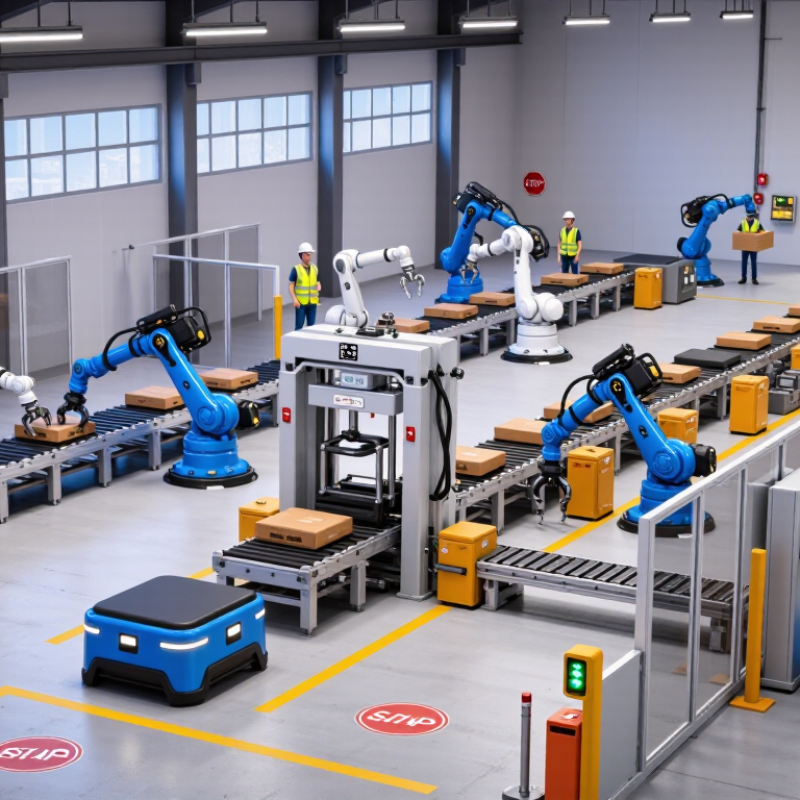
2026 Top 10 Ways to Ensure Safety in Robotic Operations
Define Robotic Operation Hazards and Safety Responsibilities
Robotic safety begins with naming hazards before assigning controls. The International Federation of Robotics reported 541,302 industrial robots installed worldwide in 2023. More machines mean more movement, stored energy, and human interaction.
A hazard review should map every phase, including loading, teaching, maintenance, recovery, and cleaning. OSHA identifies programming, setup, testing, adjustment, and repair as frequent accident points. A technician reaching through a guarded opening may face unexpected motion. A dropped part can also create a crushing or projectile hazard.
Responsibilities must be specific. Engineering should validate the risk assessment and protective systems. Operations should control access and follow approved procedures. Maintenance personnel need isolation authority, verification steps, and suitable training. Supervisors must stop production when safeguards are bypassed. Workers should report unusual noise, delayed stops, or damaged interlocks without fear.
Use ISO 10218 for industrial robot safety requirements and ISO/TS 15066 for collaborative applications. These standards support measured speed, force, separation, and stopping-distance decisions. They do not replace site-specific judgment. That part is often underestimated.
A written procedure is not enough. Observe the real cell during shift changes and fault recovery. Ask who can reset it. Ask who can enter. Record the answer.
The chart presents a practical implementation sequence based on widely recognized machine-safety principles, including risk assessment, safeguarding, control of hazardous energy, training, inspection, and emergency preparedness. The sequence is a planning guide rather than a ranking of injury rates. Responsibilities should be assigned across management, robot integrators, engineers, supervisors, operators, maintenance personnel, and safety professionals.
Reference framework: OSHA guidance on robotics and machine guarding, ISO 12100 risk assessment principles, ISO 10218 industrial robot safety requirements, and ISO 13849 functional safety principles.
A robot safety assessment should begin at the work cell, not in a meeting room. Watch normal cycles, maintenance tasks, material changes, and unexpected stops. Mark pinch points, reach zones, hot surfaces, sharp edges, and paths used by people. Record each hazard with its possible injury, likelihood, and required control.
Use a competent safety professional and involve operators who know the equipment’s daily behavior. They often notice practical risks that drawings miss. A reliable procedure should explain startup, shutdown, teaching mode, fault recovery, inspection, and emergency response. Keep instructions near the cell, with clear language and visible warning labels. Workers should demonstrate each step, not only sign a training sheet.
Test every safeguard under realistic conditions. Open the access gate. Confirm the robot stops. Check whether stored energy remains. Verify that a restart cannot occur while someone is inside the controlled area. Document test dates, responsible personnel, findings, and corrective actions. The first procedure is rarely perfect. A missed sensor fault can expose that weakness quickly.
Review the assessment after layout changes, software updates, new tooling, or an injury-free near miss. Near misses matter. Encourage workers to report them without fear of blame, then revise the procedure with evidence. A safe cell depends on disciplined habits, honest reporting, and controls that work when attention fails.
Integrate guards, sensors, and emergency stop systems as one safety strategy. Physical guards should prevent entry into hazardous workspaces during automatic operation. Use interlocked gates to stop motion when someone opens an access point. However, a guard alone is not enough. Light curtains, safety scanners, and pressure-sensitive devices can detect unexpected access or presence. Their placement must match the robot’s speed, stopping distance, and reachable area.
Emergency stop systems must be clearly visible and easy to reach. Install them near operator stations, loading points, and maintenance entrances. Pressing an emergency stop should remove hazardous motion quickly. It should not automatically restart the robot after release. A deliberate reset and controlled restart are safer. Test every device during commissioning and at scheduled intervals. Document the results. A missed test can create false confidence.
Tips: Keep safety devices separate from ordinary control buttons. Mark each emergency stop clearly. Train operators to stop, report, and wait for authorization. Inspect damaged cables, loose guards, and blocked sensors immediately. Do not bypass an interlock to save production time. That shortcut may seem harmless, but it weakens the entire system. Review the risk assessment whenever tooling, software, or workspace layouts change. Even well-designed protection can become inadequate after a small process change.
2026 Top 10 Ways to Ensure Safety in Robotic Operations
Train Workers and Control Human-Robot Interaction
Safe robotic operations begin with practical training, not a single online course. Workers should learn robot movement, emergency stops, guarding, and restart procedures. They need to recognize unexpected motion before entering a restricted area. Short demonstrations near the actual workstation often reveal hazards that manuals miss. Use supervised practice with clear limits. Keep records of attendance, skills, and refresher dates.
Human-robot interaction requires visible boundaries and reliable communication. Mark access zones on the floor, and separate maintenance paths from production routes. Interlocks, presence sensors, and speed restrictions should support trained workers, not replace them. A worker must know when collaborative operation is allowed and when isolation is required. Signals should remain simple. Confusion creates delay.
Good programs also include daily conversations. Ask operators what changed, what felt unsafe, and what almost went wrong. Near misses deserve careful review, without blaming the person who reported them. Training may fail when production pressure becomes stronger than safety rules. That weakness needs attention. Supervisors should observe real tasks and correct unsafe habits immediately. Procedures must be reviewed after equipment changes, incidents, or new assignments. A safer workplace depends on repeated practice, honest reporting, and controls that people can use correctly every shift.
2026 Top 10 Ways to Ensure Safety in Robotic Operations
Reliable robotic safety begins with active performance monitoring, not occasional inspections. Track cycle time, stopping distance, temperature, vibration, and repeated fault codes. A small delay may signal a worn brake or misaligned sensor. Use clear dashboards, but verify unusual readings at the machine. Data can mislead when calibration is overdue. Operators should record what they observe, including strange sounds, hesitation, or unexpected movement. Short notes often reveal patterns before automated alerts do.
Control updates need a documented testing process. Review speed limits, access zones, emergency stops, and restart behavior after every change. Test normal, abnormal, and maintenance conditions with the area isolated. Keep previous settings available for controlled rollback. We once treated a minor software adjustment as routine, and the review exposed an overlooked restart sequence. That mistake was uncomfortable. It improved our checklist. Train affected workers before production resumes, and confirm that instructions match the actual interface.
Incident reviews should examine system conditions, not assign convenient blame. Preserve logs, camera records, inspection notes, and operator statements quickly. Ask what the robot did, what people expected, and where those views differed. Include near misses; they provide valuable evidence without requiring injury. Review findings with maintenance, engineering, and production staff. Assign owners and deadlines for every corrective action. Recheck the change after several operating cycles. A closed form is not proof of a safer process.
| Rank | Safety Focus | Recommended Control | Measurable Indicator | Review Frequency | Required Evidence | Relevant Framework |
|---|---|---|---|---|---|---|
| 1 | Complete a documented risk assessment | Identify hazards for installation, programming, operation, maintenance, cleaning, recovery, and end-of-life activities. Apply the hierarchy of controls before relying on procedures or personal protective equipment. | 100% of robotic cells have a current risk assessment covering normal and foreseeable abnormal use. | Before commissioning and after significant change | Signed risk assessment, hazard register, residual-risk review, and action tracker | ISO 12100; ISO 10218 series |
| 2 | Use effective guarding and presence sensing | Install fixed guards, interlocked gates, light curtains, scanners, or other protective measures according to the assessed access and stopping risk. Prevent bypassing through design and controlled access. | All protective devices pass functional tests; no unauthorized bypasses are present. | At start-up, after maintenance, and at defined inspection intervals | Guarding inspection checklist, interlock test results, bypass-control log, and corrective actions | ISO 14120; ISO 14119; ISO 13855 |
| 3 | Verify emergency-stop and safe-stop functions | Ensure emergency-stop devices are accessible, clearly identified, and connected to a safety-related control function. Confirm that stopping performance is suitable for the robot, tooling, payload, and workspace. | 100% of emergency-stop devices and defined safe-stop functions pass documented tests. | Before operation, after control changes, and during scheduled inspections | Test records, stopping-distance or stopping-time verification, and fault-resolution records | ISO 13850; ISO 10218 series; IEC 60204-1 |
| 4 | Apply lockout and control hazardous energy | Identify electrical, pneumatic, hydraulic, mechanical, thermal, and stored energy. Use isolation, dissipation, verification, and release procedures before servicing or entering danger zones. | 100% of applicable maintenance tasks have an approved energy-control procedure and verification step. | Before each applicable task and whenever equipment or energy sources change | Energy-control procedures, isolation-point list, authorized-person records, and audit findings | OSHA 29 CFR 1910.147; ISO 14118 |
| 5 | Monitor robot and cell performance | Track safety-relevant alarms, protective-device trips, unexpected stops, abnormal motion, speed-limit violations, and repeated faults. Use trend data to identify deteriorating conditions before an injury occurs. | 100% of safety-related events are logged with time, equipment, condition, response, and closure status. | Continuous monitoring with weekly trend review | Event logs, dashboard trends, alarm analysis, and maintenance work orders | ISO 10218 series; ISO 13849-1 |
| 6 | Update controls and safety software | Use version control, authorization, backups, validation, and rollback procedures for robot programs, PLC logic, safety parameters, access settings, and networked control components. | 100% of control changes have documented approval, testing, version identification, and recovery capability. | Before release and after every safety-related modification | Change request, software version record, validation report, backup, and approval sign-off | ISO 13849-1; IEC 62061; IEC 62443 principles |
| 7 | Train and authorize personnel | Provide role-specific training for operators, programmers, maintenance staff, integrators, and supervisors. Cover hazards, safeguards, operating limits, recovery, reporting, and energy isolation. | 100% of personnel performing safety-sensitive tasks are trained and authorized before independent work. | Before assignment, after process changes, and at defined refresher intervals | Training matrix, competency assessment, authorization list, and refresher records | ISO 10218 series; OSHA applicable training requirements |
| 8 | Inspect, test, and maintain safety systems | Use preventive maintenance for guards, interlocks, sensors, brakes, end-effectors, cables, connectors, safety relays, and protective stops. Define acceptance criteria for each inspection. | Planned safety inspections are completed on schedule, with overdue actions escalated and tracked to closure. | Daily operator checks plus risk-based preventive maintenance | Inspection forms, maintenance history, failed-component records, and overdue-action reports | ISO 14120; ISO 10218 series; manufacturer-neutral maintenance practice |
| 9 | Review incidents, near misses, and unsafe conditions | Report injuries, near misses, unexpected robot movement, safeguard failures, bypasses, and abnormal recoveries. Investigate underlying causes rather than assigning blame. | 100% of reported events receive documented containment, root-cause analysis, corrective action, and effectiveness review. | Immediate containment; formal review within a defined site deadline | Incident report, evidence log, root-cause analysis, corrective-action plan, and effectiveness check | ISO 45001; OSHA recordkeeping and reporting requirements where applicable |
| 10 | Control changes and validate the complete cell | Reassess safety whenever tooling, payload, layout, software, operating speed, collaborative task, production method, or personnel access changes. Revalidate the integrated cell before returning it to service. | 100% of significant changes receive documented review and pre-start validation before production use. | Before restart after significant change or relocation | Management-of-change record, updated drawings, revised risk assessment, validation checklist, and release approval | ISO 12100; ISO 10218 series; ISO 13849-2 |
Review movement, stored energy, falling parts, crushing points, and unexpected starts. Include loading, teaching, maintenance, recovery, and cleaning.
Programming, setup, testing, adjustment, and repair deserve special attention. Fault recovery can be especially unpredictable.
Engineering validates risk controls. Operations manages access and procedures. Maintenance controls isolation and verification. Supervisors must stop work when safeguards are bypassed.
Report unusual noise, delayed stops, damaged interlocks, and unexpected movement. Report near misses too. Small clues matter.
Training should cover robot movement, emergency stops, guarding, and restart procedures. Use supervised practice beside the real workstation.
Mark access zones on the floor. Separate maintenance paths from production routes. Use clear signals, reliable interlocks, presence sensors, and suitable speed limits.
Workers need isolation before entering restricted areas when collaborative operation is not allowed. They should verify that movement and stored energy are controlled.
Review near misses without blaming the reporter. Supervisors should correct unsafe habits during real tasks, not only during meetings.
No. Observe shift changes and fault recovery. Ask who can reset the robot and who can enter. The procedure may still miss reality.
Review them after equipment changes, incidents, or new assignments. Refresh training when skills become uncertain. Practice must continue.
This article explains how to ensure safety in robotic operations by building a structured safety system from the ground up. It begins by identifying mechanical, electrical, software, environmental, and human-related hazards, while clearly assigning safety responsibilities to managers, engineers, operators, and maintenance staff. Organizations should conduct regular risk assessments and develop safe operating procedures covering installation, programming, normal production, maintenance, and shutdown activities.
Effective protection also requires physical guards, presence-detection sensors, access controls, and clearly accessible emergency stop systems. Workers must receive practical training on robot behavior, restricted areas, lockout procedures, and safe human-robot interaction. Finally, safety should be treated as an ongoing process: teams need to monitor system performance, inspect protective equipment, update controls when tasks or conditions change, and review incidents and near misses for lessons learned. Consistent communication, documentation, and continuous improvement help reduce risks while supporting reliable and efficient robotic operations.

TC MediGroup